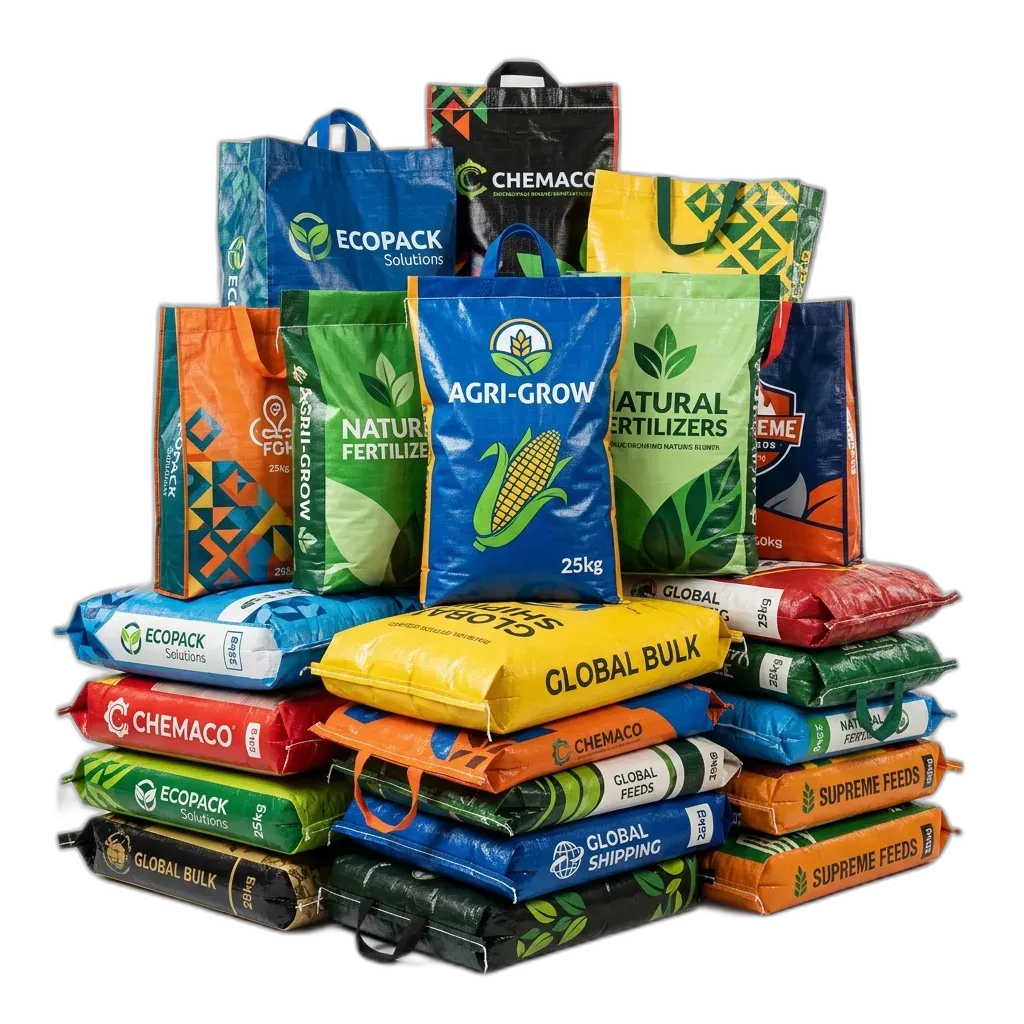
Selecting the perfect polypropylene (PP) woven bag is a strategic decision that impacts your brand's image, your logistics efficiency, and ultimately, your bottom line. An under-specced bag can lead to disastrous product loss during transport, while an over-specced bag wastes money on unnecessary features.
Welcome to the definitive 15-Step Buyer's Guide for PP Woven Bags. Whether you are packaging fine wheat flour in Iraq, heavy-duty construction cement in Central Asia, or moisture-sensitive fertilizers in Russia, this systematic framework will empower you to specify, evaluate, and purchase the exact packaging solution your industry demands.
1. The Hidden Cost of Poor Packaging Decisions
Many procurement managers make the mistake of buying PP bags based solely on price per piece. This approach almost always leads to higher overall costs. Why? Because the cost of packaging failure far exceeds the few cents saved on a cheaper bag.
Burst Failures
Choosing a GSM that is too low for your product weight leads to bags bursting under compression in the warehouse. A single burst bag of cement can ruin the entire pallet and halt operations.
Moisture Contamination
Failing to include a PE liner or lamination for hygroscopic products (like sugar or fertilizer) allows humidity to seep in, causing the product to clump or spoil before reaching the consumer.
UV Degradation
Standard PP degrades in sunlight. If your bags are stored outdoors for weeks without UV stabilizers, the fabric becomes brittle and turns to dust when lifted.
Define Weight Capacity & Sizing
The foundational step in ordering PP woven bags is matching the physical structure of the bag to the weight and density of your product. Bag dimensions are always listed as Width × Length.
Sizing: The Dimension Equation
Because different products have different bulk densities, a 50kg bag of wheat requires different dimensions than a 50kg bag of flour.
- ✅ 50kg Flour: Typically 60cm × 90cm (flour is fluffy and less dense)
- ✅ 50kg Wheat/Rice: Typically 55cm × 90cm or 60cm × 100cm
- ✅ 50kg Cement: Typically 50cm × 65cm (cement is highly dense)
Rule of Thumb: Always ask your supplier for sample bags to run physical filling tests on your specific packaging line before placing a bulk order. Allow an extra 10-15cm at the top for sewing/closing.
Selecting the Right GSM
GSM (Grams per Square Meter) determines the thickness and strength of the fabric. The higher the GSM, the stronger and heavier the bag.
| Load Weight | Recommended GSM | Ideal Products |
|---|---|---|
| 5kg - 15kg | 45g - 55g | Retail rice, small seed bags, pulses |
| 20kg - 30kg | 55g - 65g | Animal feed, wholesale grains, chemicals |
| 40kg - 50kg | 65g - 85g | Wheat, flour, sugar, fertilizers, salt |
| 50kg+ (Heavy Duty) | 90g - 120g | Cement, sand, gravel, minerals |
Mesh Count and Fabric Density
Mesh count refers to the number of PP tapes woven in a one-inch square. Common configurations include 10x10, 11x11, 12x12, and 14x14. A tighter mesh (e.g., 14x14) provides a smoother surface for printing and better sift-proofing for fine powders. A looser mesh allows for better air circulation, crucial for agricultural products like potatoes.
Assess Material Sensitivity (PE Liners)
Standard PP woven fabric is porous; it breathes. While this is excellent for products like potatoes or certain grains that need ventilation, it is disastrous for fine powders or moisture-sensitive goods.
Inner PE Liners
A separate or loosely stitched Polyethylene (PE) bag placed inside the PP woven shell. Provides the ultimate hermetic seal against moisture and air.
- ✔ 100% moisture proof
- ✔ Prevents fine powders from sifting
- ✔ Food safe (keeps product pure)
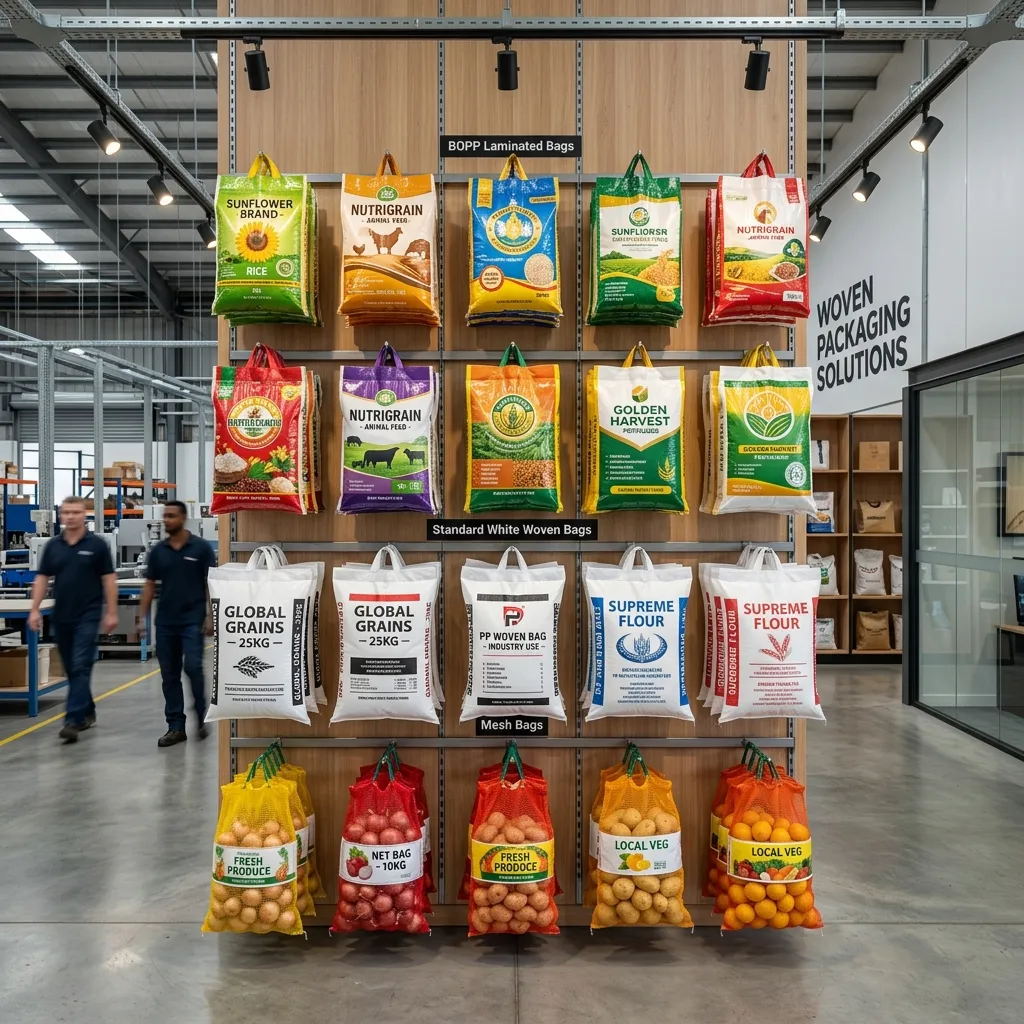
Outer Lamination (BOPP vs PE)
Outer Lamination (Coating)
A thin layer of melted PP/PE applied directly to the outside (or inside) of the woven fabric. Seals the pores without needing a separate inner bag.
- ✔ Water and dust resistant
- ✔ Improves printing surface
- ✔ Prevents fraying when cut
UV Protection Requirements
☀️ Don't Forget UV Stabilization
If your bags will be exposed to direct sunlight for more than a few days, you must specify UV stabilization. This is a chemical additive (HALS) mixed into the polymer. Specify the required lifespan, typically ranging from 200 hours to 1600 hours of UV exposure. It adds marginal cost but saves thousands in ruined inventory.
Branding & Flexographic Printing
Your packaging is your silent salesman. In wholesale markets, bright, clear printing commands authority. Flexographic printing is the standard industrial printing method where rubber plates press ink directly onto the woven fabric.
Flexographic Printing
- • Supports 1 to 4 basic colors
- • Good for bold logos, text, and simple vectors
- • Cost-effective for large and small runs
- • Cannot print photographs or complex gradients
Ideal for: Wholesale wheat, cement, sand, bulk fertilizers.
Advanced Rotogravure (BOPP) Printing
BOPP Laminated (Rotogravure)
A pre-printed BOPP (Biaxially Oriented Polypropylene) film is laminated onto the bag. Delivers magazine-quality images.
- • Photographic quality, up to 10 colors
- • Glossy or matte finish available
- • Scuff-resistant (printing is trapped under the film)
- • Higher setup cost (engraved steel cylinders required)
Ideal for: Premium retail rice, pet food, premium fertilizers.
Closure Types Deep Dive
How will the bags be filled? How will they be stacked? These operational questions dictate the top and bottom finishing of the bag.
| Closure Type | Description & Use Case | Filling Method |
|---|---|---|
| Heat Cut / Cold Cut Top | Simple unhemmed top. The cheapest option. Suitable for manual filling where the top is tied or sewn shut post-filling. | Manual |
| Hemmed Top | Top edge is folded over and sewn. Prevents fraying. Essential for semi-automated filling spouts. | Semi-Auto |
| Valve Top (Block Bottom) | Fully enclosed bag with a small self-sealing valve. The bag seals itself from the internal pressure of the product. | High-Speed Auto |
| Gusseted Sides | Folds on the sides allow the bag to become square when filled. Dramatically improves stable pallet stacking. | Any |
Palletizing and Anti-Slip Features
📦 Palletizing Secret: Anti-Slip Coating
Standard PP woven fabric is slippery. If you are stacking bags on pallets for export shipping, always request an anti-slip weave (twisted yarn) or an anti-slip coating. This creates friction between the bags, preventing pallets from collapsing during truck or sea transit. It is a minor adjustment that saves massive logistical headaches.
Cost Optimization Strategies
How do you lower the price per bag without compromising quality? The secret lies in intelligent specification design.
1. Optimize Mesh Count over GSM
▼
2. Consolidate Cylinder Costs (BOPP)
▼
3. Maximize Container Volume
▼
Supplier Evaluation & Factory Audits
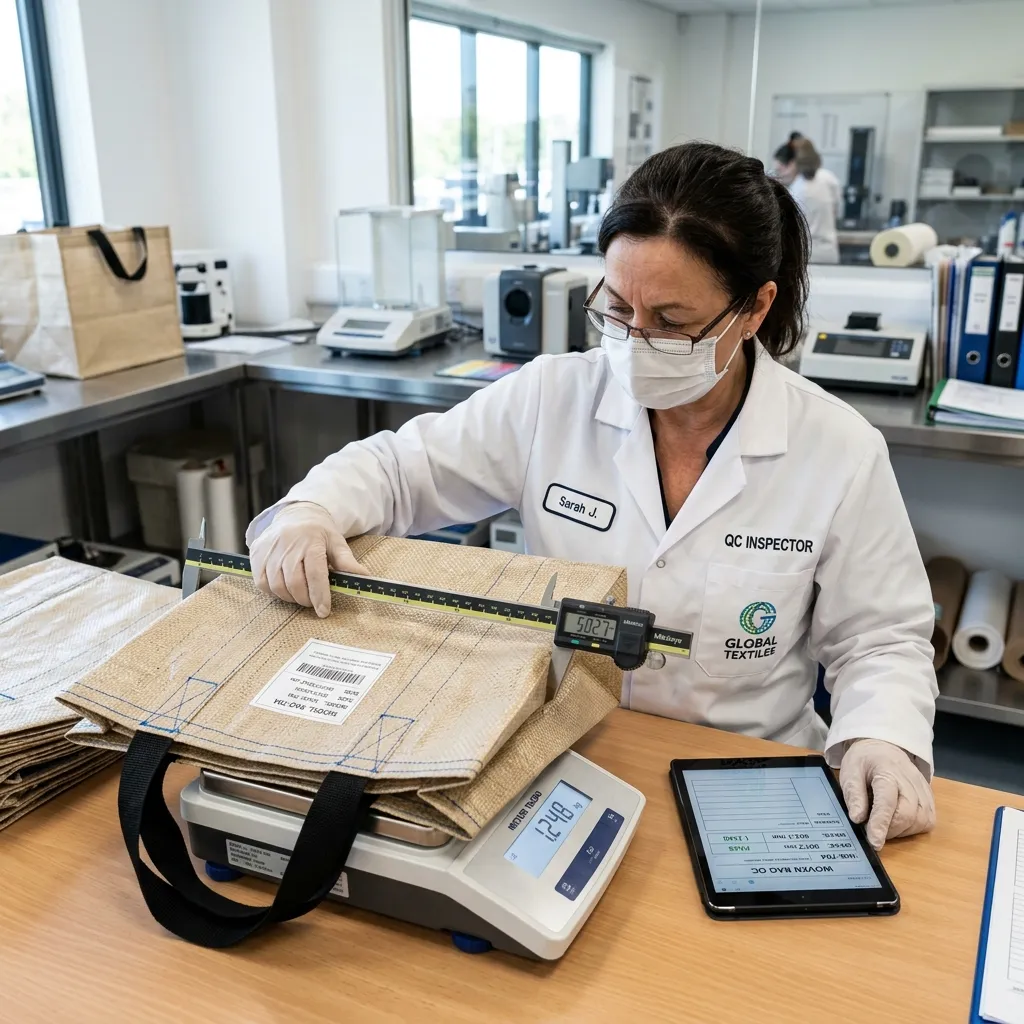
Never purchase blindly. Request factory audit reports or conduct a video tour. Look for ISO 9001 (Quality Management) and ISO 22000 (Food Safety) certifications. Check the condition of their circular looms and printing presses. A clean, modern factory produces consistent, defect-free bags.
Quality Control Checklist for Buyers
- ✅ Drop Test: Can the bag survive a 1.2m drop when fully loaded?
- ✅ Tensile Strength: Request fabric pull-test reports.
- ✅ Seam Strength: Ensure the bottom stitching is double-folded.
- ✅ Print Adhesion: Tape test the printed area to check for ink flaking.
Conclusion & Ordering Process
Ready to Engineer Your Perfect Bag?
Now that you understand GSM, Denier, laminations, factory audits, and printing types, you are ready to request a professional quote. Do not settle for off-the-shelf packaging that doesn't serve your brand.
Request a Custom Quote Today
The Ultimate 15-Step Buyer's Guide to PP Woven Bags: Specifications, Quality Control, and Export
The Ultimate 15-Step Buyer's Guide to PP Woven Bags: Specifications, Quality Control, and Export
The Ultimate 15-Step Buyer's Guide to PP Woven Bags: Specifications, Quality Control, and Export